
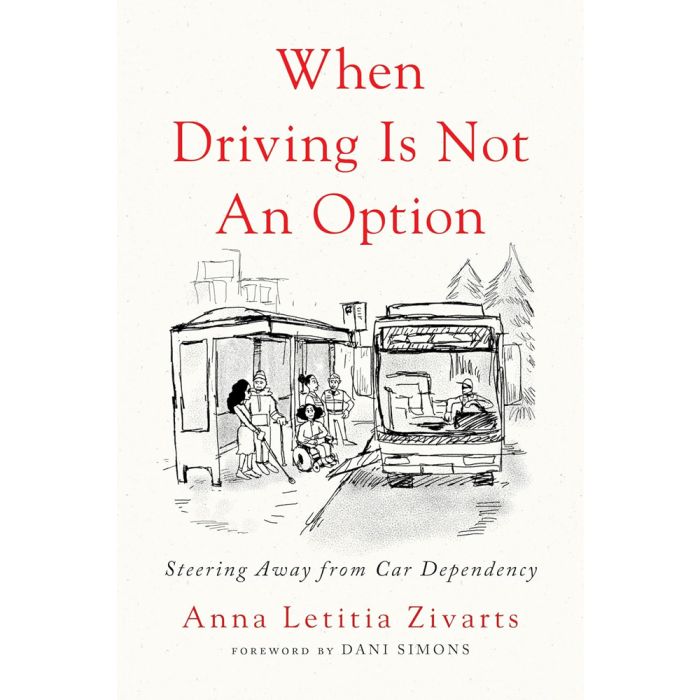
When Driving Is Not an Option Book
One third of people living in the United States do not have a driver license. Because the majority of involuntary nondrivers are disabled, lower income, unhoused, formerly incarcerated, undocumented immigrants, kids, young people, and the elderly, they are largely invisible. The consequence of this invisibility is a mobility system designed almost exclusively for drivers. This system has human-health, environmental, and quality-of-life costs for everyone, not just for those excluded from it. If we’re serious about addressing climate change and inequality, we must address our transportation system.
In When Driving is Not an Option disability advocate Anna Letitia Zivarts shines a light on the number of people in the US who cannot drive and explains how improving our transportation system with nondrivers in mind will create a better quality of life for everyone.
Drawing from interviews with involuntary nondrivers from around the US and from her own experience, Zivarts explains how nondrivers get around and the changes necessary to make our communities more accessible. These changes include improving sidewalk connectivity; providing reliable and affordable transit and paratransit; creating more options for biking, scooting, and wheeling; building more affordable and accessible housing; and the understanding the unrecognized burden of asking and paying for rides.
Zivarts shows that it is critical to include people who can’t drive in transportation planning decisions. She outlines steps that organizations can take to include and promote leadership of those who are most impacted—and too often excluded—by transportation systems designed by and run by people who can drive. The book ends with a checklist of actions that you, as an individual living in a car-dependent society, can take in your own life to help all of us move beyond automobility.
When the needs of involuntary nondrivers are viewed as essential to how we design our transportation systems and our communities, not only will we be able to more easily get where we need to go, but the changes will lead to healthier, climate-friendly communities for everyone.
Out of stock
Description / When Driving Is Not an Option Book
One third of people living in the United States do not have a driver license. Because the majority of involuntary nondrivers are disabled, lower income, unhoused, formerly incarcerated, undocumented immigrants, kids, young people, and the elderly, they are largely invisible. The consequence of this invisibility is a mobility system designed almost exclusively for drivers. This system has human-health, environmental, and quality-of-life costs for everyone, not just for those excluded from it. If we’re serious about addressing climate change and inequality, we must address our transportation system.
In When Driving is Not an Option disability advocate Anna Letitia Zivarts shines a light on the number of people in the US who cannot drive and explains how improving our transportation system with nondrivers in mind will create a better quality of life for everyone.
Drawing from interviews with involuntary nondrivers from around the US and from her own experience, Zivarts explains how nondrivers get around and the changes necessary to make our communities more accessible. These changes include improving sidewalk connectivity; providing reliable and affordable transit and paratransit; creating more options for biking, scooting, and wheeling; building more affordable and accessible housing; and the understanding the unrecognized burden of asking and paying for rides.
Zivarts shows that it is critical to include people who can’t drive in transportation planning decisions. She outlines steps that organizations can take to include and promote leadership of those who are most impacted—and too often excluded—by transportation systems designed by and run by people who can drive. The book ends with a checklist of actions that you, as an individual living in a car-dependent society, can take in your own life to help all of us move beyond automobility.
When the needs of involuntary nondrivers are viewed as essential to how we design our transportation systems and our communities, not only will we be able to more easily get where we need to go, but the changes will lead to healthier, climate-friendly communities for everyone.